
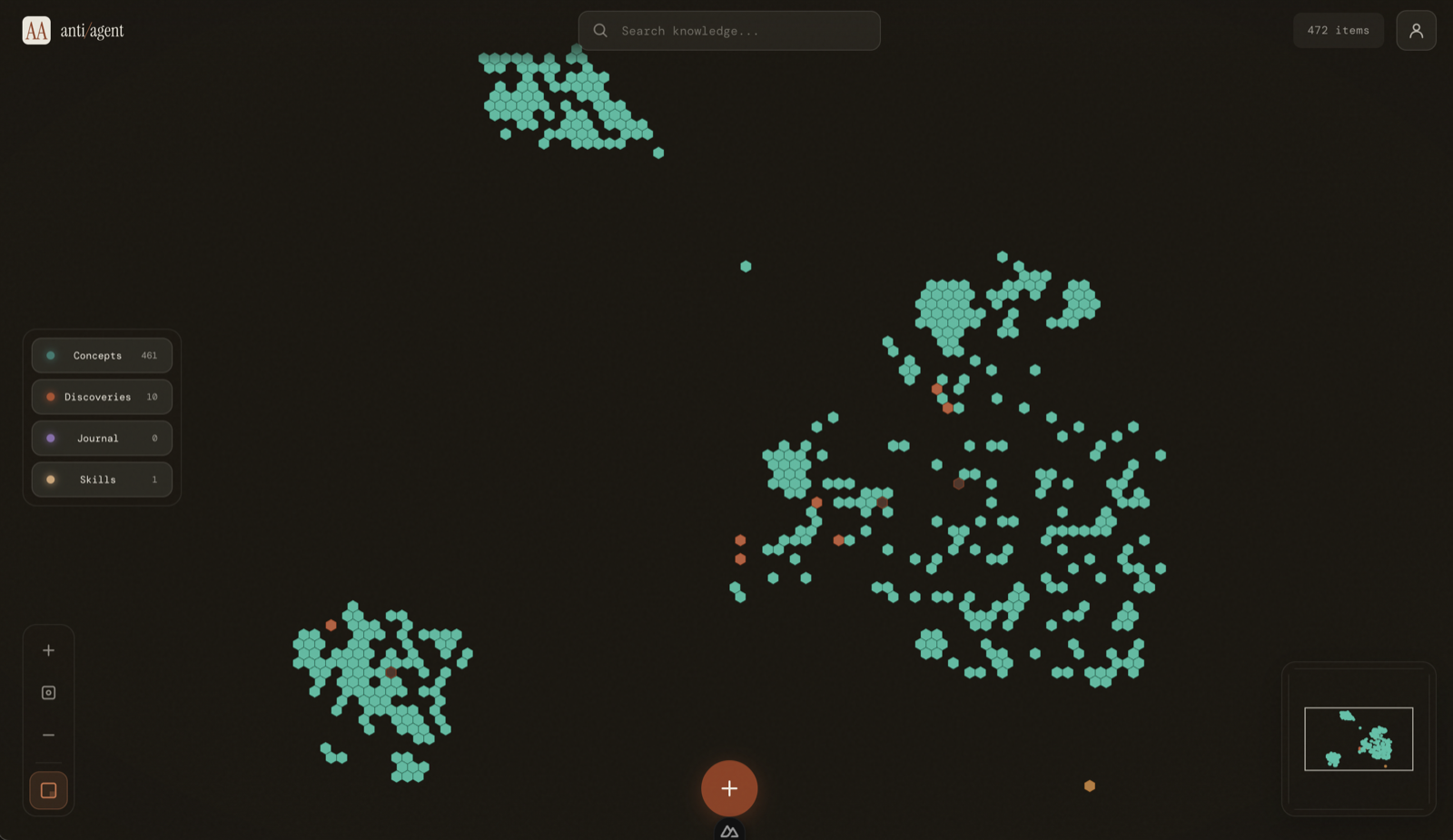
A semantic knowledge map is a living visualization of your understanding—concepts, connections, and evolving insights rendered in space. Unlike traditional note-taking or filing systems, the map emphasizes relationships over storage: what matters isn't where knowledge lives, but how it connects.
This is a fundamentally different approach to personal knowledge: Most people accumulate information. A semantic map accumulates meaning.
Why Maps, Not Files
Files and folders impose hierarchy. You must decide: does this note belong under "Psychology" or "Decision Making"? This is the wrong question. Knowledge isn't hierarchical—it's networked. A concept about cognitive bias relates simultaneously to psychology, economics, self-improvement, and that conversation you had last Tuesday.
Prefer topological organization to hierarchical taxonomy. A map has no folders. Concepts exist in relation to other concepts. Their position emerges from meaning, not from arbitrary categorization decisions made at capture time.
Principles of the Semantic Knowledge Map
Knowledge should be concept-oriented, not source-oriented
Most note systems organize by source: "Notes from Book X," "Meeting notes from Y." This fragments understanding. The same concept appears across dozens of sources, never unified.
A semantic map inverts this. The atomic unit is the concept, not the source. When you encounter compound interest in a finance book, a psychology paper on delayed gratification, and a conversation about habit formation—these converge on the same conceptual node. Sources feed concepts; concepts are what you actually think with.
Connections are first-class citizens
In a file system, links are afterthoughts—something you add if you remember. In a semantic map, connections are the primary structure. The value of a concept increases with its connections. An isolated idea is trivia; a densely connected concept is a thinking tool.
The map makes connections visible and spatial. Related concepts cluster. Surprising connections create bridges between distant regions. Over time, you develop intuition for where new knowledge fits—and which distant concepts it might illuminate.
Knowledge should surface, not sink
Most captured information sinks. You highlight a book, take a note, file it away—and never see it again. The act of capture creates an illusion of retention while the insight quietly disappears.
A semantic map is proactive. Knowledge resurfaces through spaced repetition, through serendipitous connection, through conversational review. The map isn't a graveyard of past reading; it's a living system that brings relevant concepts back when you need them—and sometimes when you don't expect them.
Capture should be effortless; understanding requires effort
Traditional knowledge systems demand effort at the wrong moment. You must stop reading to format a note, decide on tags, choose a location. This friction kills capture.
The semantic map separates these concerns. Capture is frictionless—send a photo, paste a quote, speak a thought. The AI extracts concepts automatically. Later, through spaced review, you engage with the concept deeply. The effort shifts from administrative formatting to genuine understanding.
The map is a mirror of your mind
Your semantic map isn't trying to be Wikipedia. It doesn't need to be comprehensive or objectively organized. It's yours—shaped by your interests, your questions, your unique path through ideas.
Write concepts for yourself, not an imagined audience. The map should reflect how you think about a concept, not how a textbook defines it. Personal context makes knowledge retrievable. "That idea about feedback loops that explained why my morning routine keeps failing" is more useful than a generic definition.
Four Types of Knowledge
Not all knowledge is the same. The semantic map recognizes four distinct types, each serving a different purpose in your cognitive ecosystem:
Concepts
Concepts are the core units of understanding—ideas extracted from books, articles, conversations, and experiences. They're atomic and reusable. A concept like "compounding" appears once but connects to finance, habits, relationships, and learning itself.
Concepts are what you think with. They're the building blocks of insight, the lenses through which you interpret new information. The more concepts you've internalized, the richer your mental models.
Journal
Journal entries capture reflection—your thoughts, observations, and personal experiences. Unlike concepts, journals are inherently temporal. They're snapshots of your thinking at a moment in time.
But journals aren't just diaries. They're raw material for future insight. A frustration you noted three months ago might suddenly connect to a concept you learned yesterday. The map surfaces these connections, turning personal experience into transferable wisdom.
Skills
Skills are knowledge in action—practical abilities you're developing through deliberate practice. Learning Spanish verb conjugation. Improving your writing. Mastering a programming framework.
Skills connect to concepts (the theory behind the practice) and to journals (your experience developing the skill). They require a different kind of review: not just recall, but active application and feedback.
Discoveries
Discoveries are serendipitous findings—unexpected connections, new ideas, and "aha" moments that emerge from the interplay of other knowledge types. The AI surfaces discoveries by noticing relationships you might have missed.
"You learned about deliberate practice from Ericsson. Combined with your journal entry about feeling stuck on guitar, this suggests a specific approach..." Discoveries are where the map becomes generative, creating new knowledge from existing elements.
Semantic Search: Find by Meaning
Traditional search is keyword-based. You type "feedback" and find notes containing that exact word. This fails when you remember the idea but not the exact terminology you used.
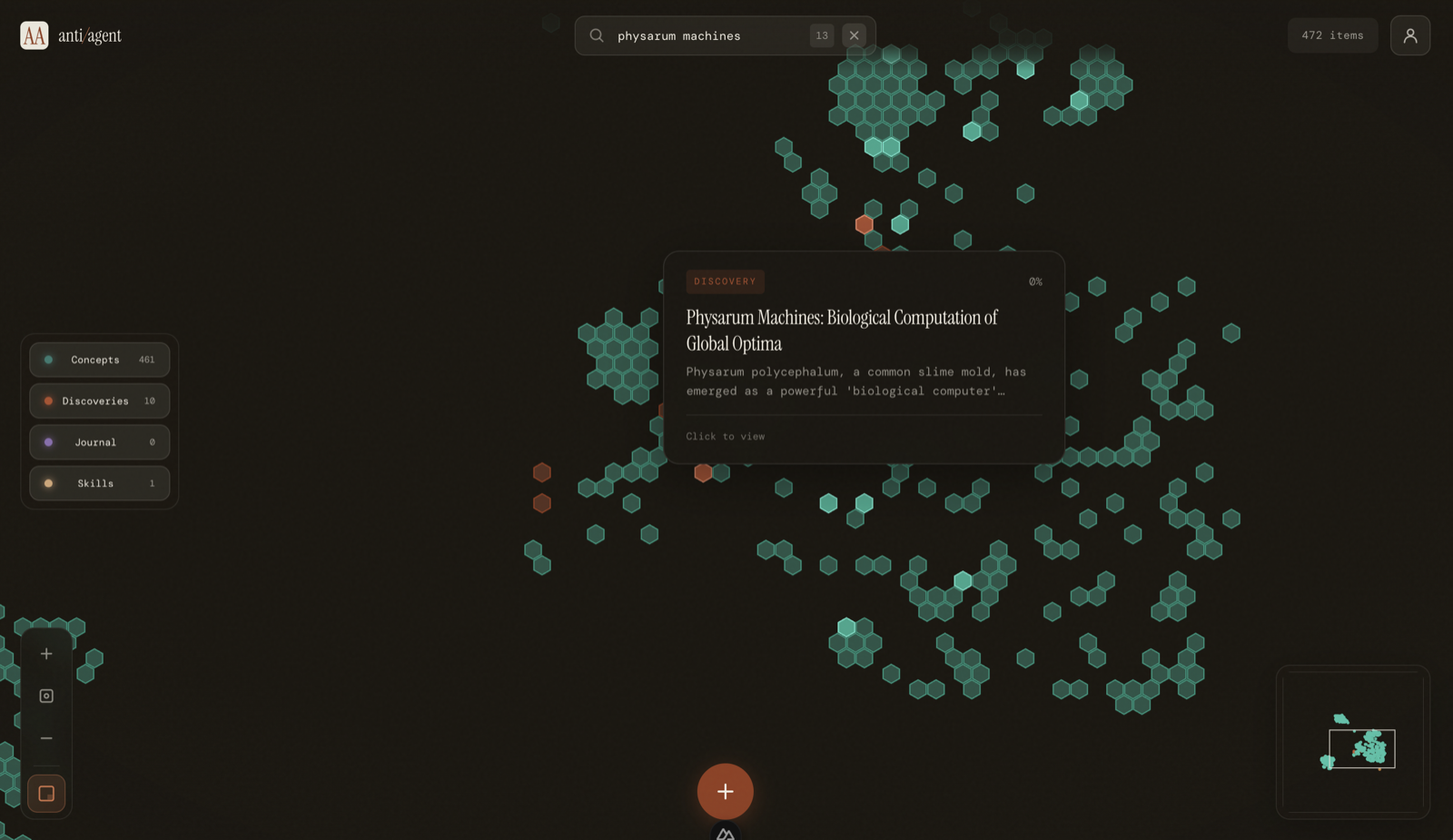
The semantic map uses meaning-based search. Search "why habits fail" and find your note about "implementation intentions" even though those words don't overlap. Search "biological computing" and find that article about slime mold optimization you captured months ago.
This transforms retrieval. Your past knowledge becomes truly accessible—not buried under forgotten terminology, but findable through the concepts themselves.
The Power of Interleaving
Here's where the semantic map diverges most radically from traditional learning tools: interleaved review.
Most learning systems use blocked practice. You study chemistry, then biology, then physics—one subject at a time. Flashcard apps show you all the cards from one deck before moving to the next. This feels efficient but produces shallow retention.
Research consistently shows that interleaving—mixing different topics and types of practice—dramatically improves long-term retention and transfer. The struggle to switch contexts strengthens memory. The unexpected juxtapositions reveal connections.
How the map interleaves naturally
Because the semantic map contains four knowledge types—concepts, journals, skills, and discoveries—review sessions naturally interleave:
- A concept from a psychology book
- A journal reflection from last week
- A skill practice session for Spanish
- A discovery connecting two previous concepts
- Another concept, this time from economics
This mixing isn't random—it's optimal for learning. Each transition forces your brain to reconstruct context, strengthening retrieval pathways. And the variety keeps review engaging rather than monotonous.
Cross-type connections
Interleaving also reveals connections between knowledge types that siloed systems miss:
- A concept about feedback loops connects to a journal entry about why your exercise habit keeps failing
- A skill you're practicing in negotiation links to concepts from game theory and psychology
- A discovery emerges from the pattern across several journal entries you hadn't consciously connected
The boundaries between knowledge types are permeable. A journal entry might evolve into a concept. A concept might spawn a skill you want to develop. This fluidity is how real thinking works—and how the map supports it.
From Collection to Cognition
The deeper purpose isn't to build an impressive archive. It's to think better.
When concepts are atomic and connected, you can recombine them. When knowledge resurfaces regularly, you can build on it. When capture is effortless, you actually capture. When the map is visual, you see patterns invisible in linear notes. When review interleaves across types, retention deepens and connections multiply.
"Better knowledge management" misses the point; what matters is "better thinking."
The map is a prosthetic for cognition—extending your ability to hold ideas in mind, see connections across time, and develop understanding that compounds rather than fades.
The Living Map
Unlike static notes, a semantic map evolves:
- Concepts mature. Initial captures are raw. Through review and connection, they become refined understanding.
- Journals accumulate. Over months, patterns emerge in your reflections that reveal deeper truths about how you work, think, and live.
- Skills develop. Tracked progress shows you how far you've come and what needs more practice.
- Discoveries compound. Each new connection makes future connections more likely. The map becomes increasingly generative.
- Clusters emerge. Natural groupings appear—not because you filed them together, but because they genuinely relate.
- Bridges form. The most valuable moments come when a new concept connects two previously separate regions of your map, revealing relationships you hadn't seen.
The map isn't a product to complete. It's a practice to maintain—a lifelong accumulation of connected, evolving understanding.
Getting Started
You don't need to import your entire note archive. Start with what you're learning now:
- Capture one concept from something you read today
- Write one journal entry reflecting on your day
- Add one skill you're actively trying to improve
- Let discoveries emerge as the AI finds connections
Over weeks, your map grows. Over months, it becomes indispensable. Over years, it becomes a genuine extension of your mind.
The best time to start building your semantic knowledge map was years ago. The second best time is now.